Web or desktop
Claude
Settings → Connectors → Add custom connector → paste https://www.scento.com/mcp.
The perfume knowledge connector for AI assistants
Scento Perfume API is the perfume knowledge connector for AI assistants: 1,400+ designer and niche perfumes, 400+ raw materials and Scento's own family system, with every answer tied to a page on scento.com. No key, no account.
One free perfume API, fragrance API and perfume notes API: call the REST routes with curl, or add the MCP server to Claude, ChatGPT, Cursor or VS Code. Free, no API key.
One URL for every client
https://www.scento.com/mcpPrefer to browse? The same data is open as the Scento perfume database.
Docs: Free Perfume API · Perfume MCP Server · Perfume database
Connect
One remote server, no key needed. Paste https://www.scento.com/mcp where your client asks for a connector or an MCP server.
Available in Claude’s connectors directory
Web or desktop
Settings → Connectors → Add custom connector → paste https://www.scento.com/mcp.
Terminal
claude mcp add --transport http scento-perfume-api https://www.scento.com/mcpDeveloper mode
Settings → Apps → Advanced → developer mode → Create → paste https://www.scento.com/mcp, authentication None.
Any MCP client
Add this to mcpServers:
{
  "mcpServers": {
    "scento-perfume-api": {
      "type": "http",
      "url": "https://www.scento.com/mcp"
    }
  }
}Demo
One minute: a perfume portrait, two perfumes side by side, and the perfumes built on the same raw materials. Every answer is the live response of the server.
Tools
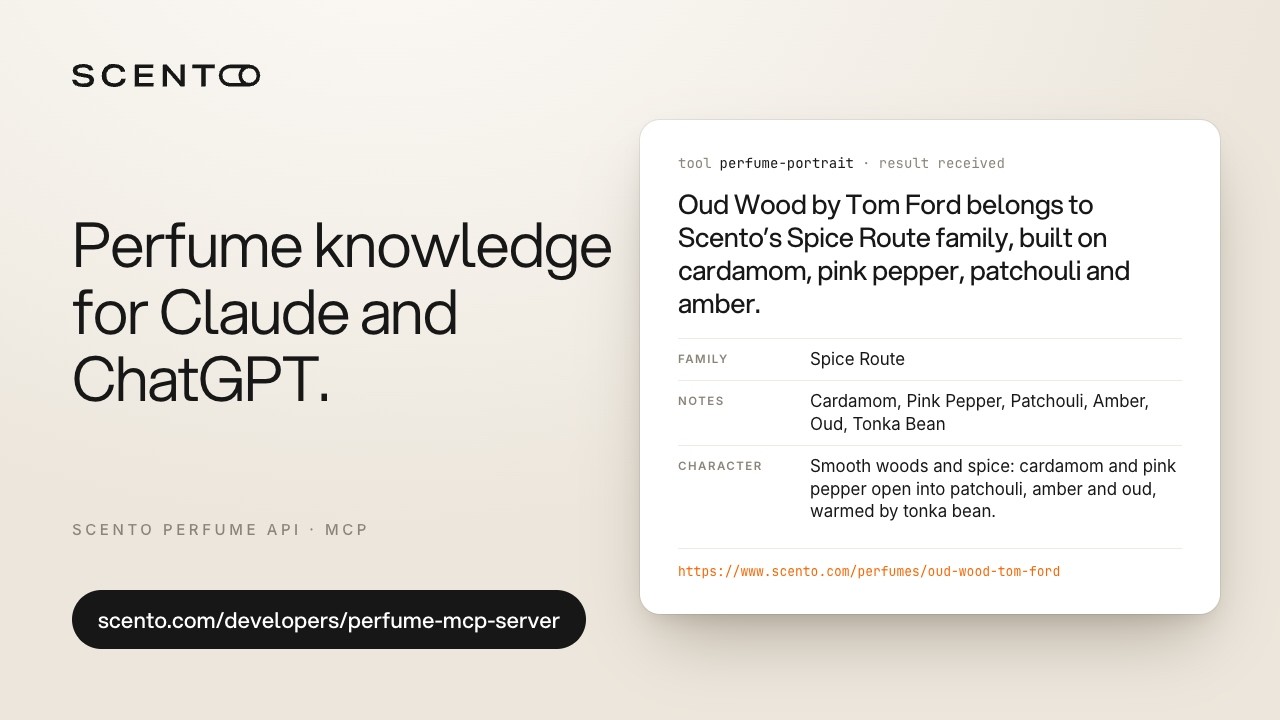
Each answer is a folio: a lede an assistant can quote, the detail, the scento.com page to read on and a line to cite.
perfume-search
Use this when the user asks to find a perfume, fragrance, cologne or scent by name, house, note or mood, or when a name is uncertain (synonyms: perfume, fragrance, cologne, eau de parfum, scent, brand, notes, smells like). Returns matching perfumes, houses and raw materials with house, Scento family and a scento.com link in the user's language, ten per page. Call this first when a name is ambiguous. Don't use for a perfume's full notes (use perfume-portrait), similar scents (scent-neighbours) or articles (journal-search).
perfume-portrait
Use this when the user asks what a specific perfume, fragrance or cologne smells like, what its notes or pyramid (top, heart, base) are, its family, perfumer, year or concentration (eau de parfum, eau de toilette), or when to wear it (synonyms: notes of, what's in it, how does it smell). Returns the verified note pyramid, Scento family and subfamily, character, seasons and hours, signature materials and the scento.com page in the user's language. Don't use to find similar perfumes (use scent-neighbours), compare perfumes (perfume-contrast) or search by mood (perfume-search).
scent-neighbours
Use this when the user asks for perfumes similar to, like or in the same style as a given perfume, fragrance or cologne, or what else to try if they love it (synonyms: similar to, smells like, more like, if I like X). Returns the perfumes that share the most notes and structure with it, with the shared materials named, one line on how each differs and scento.com links in the user's language. Don't use for one perfume's own notes (perfume-portrait), a side-by-side of named perfumes (perfume-contrast) or a whole collection (wardrobe-composer).
perfume-contrast
Use this when the user asks to compare, contrast or choose between two to four named perfumes, fragrances or colognes (synonyms: versus, vs, difference between, which one). Returns the perfumes side by side on house, Scento family, top, heart and base notes, shared materials, character, seasons, hours, year and concentration, with scento.com links in the user's language. Don't use to find new perfumes (scent-neighbours or perfume-search) or to explain a single perfume (perfume-portrait).
note-portrait
Use this when the user asks what a note or raw material smells like or is (for example vetiver, oud, vanilla, iris, ambroxan, bergamot), whether it is natural or synthetic, or what it pairs with (synonyms: what does X smell like, ingredient, note). Returns how it smells, its family, natural or synthetic, pairings and perfumes that show it, with the scento.com page in the user's language. Don't use to find perfumes containing notes (use material-match) or to define a perfumery term such as sillage (perfumery-lexicon).
material-match
Use this when the user wants perfumes, fragrances or colognes that contain specific notes or raw materials, optionally in the top, heart or base (synonyms: with notes of, built on, smells of, containing; for example vanilla and tobacco in the base). Returns the perfumes that have every material given, with house, where each sits in the pyramid and scento.com links in the user's language. Don't use to explain one material (note-portrait), to find perfumes like a named perfume (scent-neighbours) or for a mood or occasion (occasion-edit).
house-portrait
Use this when the user asks about a perfume house, brand or maison (for example Creed, Le Labo, Amouage): where it is from, when it was founded, its style and its signature perfumes. Returns country, founding year, style, signature perfumes with their families and the scento.com house page in the user's language. Don't use for one perfume (use perfume-portrait) or to list perfumes with a given note (material-match). If the house name is uncertain, call perfume-search with kind "house" first.
family-map
Use this when the user asks how fragrances are grouped or what a scent family is (for example woody, floral, amber, fresh, citrus), or wants the exemplar perfumes of one family (synonyms: scent families, fragrance categories, olfactive families). Returns Scento's own family system: the whole tree, or one family with its definition, subfamilies, exemplar perfumes and neighbouring families, with the scento.com guide. Don't use for one perfume's family (perfume-portrait), a perfumery term (perfumery-lexicon) or an occasion (occasion-edit).
occasion-edit
Use this when the user asks which perfume, fragrance or cologne to wear for one occasion, season or climate: wedding, office, date night, night out, weekend, everyday, gym or sport (workout), summer days, cold weather, first impressions, long-lasting or under-the-radar. Returns a short edit of perfumes with a line on why each fits and a scento.com link for each, in the user's language. The occasion is a fixed list, so pick the nearest value; omit gender_lean unless the user states one. For several occasions call it once per occasion. Don't use for a collection built around perfumes the user already loves (wardrobe-composer) or for similar scents (scent-neighbours).
wardrobe-composer
Use this when the user wants a small fragrance wardrobe or collection (three to five perfumes for different moments) built around perfumes or notes they already love, or asks what to add next (synonyms: signature scents, collection, rotation, what else should I own). Returns roles such as daytime, evening and warm weather, each with a perfume, its house, why it fits and a scento.com link in the user's language. Don't use for a single occasion (occasion-edit) or the neighbours of one perfume (scent-neighbours).
perfumery-lexicon
Use this when the user asks what a perfume or fragrance term means: sillage, projection, longevity, drydown, top, heart and base notes, accord, chypre, fougère, gourmand, oud, layering, eau de parfum versus eau de toilette (EDP vs EDT), concentration, flanker or niche versus designer. Returns a plain-language meaning, example perfumes and related terms, with the matching scento.com guide in the user's language. Don't use for a specific note (use note-portrait) or a specific perfume (perfume-portrait).
journal-search
Use this when the user wants articles, guides or background reading on a perfume, fragrance, cologne, house, note or topic (for example layering, vetiver, how to make a scent last). Returns matching Scento journal articles with title, one-line summary and scento.com link in the user's language. Use it to give the reader something to read on. Don't use for a perfume's notes (perfume-portrait), a house profile (house-portrait) or a term's meaning (perfumery-lexicon).
REST API
Prefer plain HTTP? The same answers live under https://www.scento.com/api/perfume/v1. Every route takes lang, and lists take continuation.
Free, no API key: a perfume with its notes, family and wear, in one request.
curl "https://www.scento.com/api/perfume/v1/perfumes/layton"{
"folio": "perfume-portrait",
"lede": "Layton by Parfums de Marly belongs to Scento’s Wood & Root family: apple, bergamot and cardamom open onto lavender, violet and geranium, settling on patchouli, vanilla, guaiac wood and praline.",
"detail": {
"name": "Layton",
"house": "Parfums de Marly",
"year": null,
"perfumer": null,
"concentration": "eau de parfum",
"family": "Wood & Root",
"subfamily": "Velvet Sweet",
"pyramid": {
"top": [
"Apple",
"Bergamot",
"Cardamom"
],
"heart": [
"Lavender",
"Violet",
"Geranium"
],
"base": [
"Patchouli",
"Vanilla",
"Guaiac Wood",
"Praline"
]
},
"notes": null,
"character": "An apple-and-lavender blend: bergamot and cardamom up top, violet and geranium in the middle, patchouli, vanilla and praline below.",
"character_words": [
"sweet",
"warm",
"fresh",
"herbal"
],
"wears": {
"seasons": [
"spring",
"summer",
"autumn"
],
"hours": [
"day",
"evening"
]
},
"signature_materials": [
"Patchouli",
"Guaiac Wood"
]
},
"scento_page": {
"label": "Layton on Scento",
"url": "https://www.scento.com/perfumes/layton-parfums-de-marly"
},
"further_reading": [
{
"label": "Parfums de Marly on Scento",
"url": "https://www.scento.com/brand/parfums-de-marly"
},
{
"label": "Patchouli, the note",
"url": "https://www.scento.com/note/patchouli"
},
{
"label": "Guaiac Wood, the note",
"url": "https://www.scento.com/note/guaiac-wood"
}
],
"cite": "Scento Perfume API, scento.com",
"continuation": null
}More routes to try:
A perfume portrait
curl "https://www.scento.com/api/perfume/v1/perfumes/oud-wood?lang=de"Scent neighbours
curl "https://www.scento.com/api/perfume/v1/perfumes/layton/neighbours"Side by side
curl "https://www.scento.com/api/perfume/v1/contrast?perfumes=mojave-ghost,gypsy-water"A raw material
curl "https://www.scento.com/api/perfume/v1/materials/ambroxan"Built on these materials
curl "https://www.scento.com/api/perfume/v1/materials/match?materials=tobacco,vanilla&tier=base"The family map
curl "https://www.scento.com/api/perfume/v1/families"An occasion edit
curl "https://www.scento.com/api/perfume/v1/edits/summer-days?lang=fr"Search the journal
curl "https://www.scento.com/api/perfume/v1/journal?q=vetiver"Full docs on the Free Perfume API and Perfume MCP Server pages. Described in OpenAPI 3.1 · MCP server card
FAQ
Scento Perfume API turns Claude into a well-read perfume adviser. Ask it to portray a perfume, contrast two you are torn between, find scents built on the same structure, explain a raw material such as orris or ambroxan, introduce a house, or compose a wardrobe and an edit for an occasion. Answers draw on Scento's verified perfume database: 1,400+ designer and niche perfumes with full note pyramids, 400+ raw materials and Scento's own family map. Every answer links to the matching page on scento.com in ten languages. Read-only, no account, no key.
No. Scento Perfume API is free and read-only. Add https://www.scento.com/mcp to your assistant, or call the Scento Perfume API at https://www.scento.com/api/perfume/v1, and it answers straight away: no key, no account, no sign-up.
Claude on the web and desktop, Claude Code, ChatGPT in developer mode, Cursor, VS Code, Windsurf and any other client that speaks the Model Context Protocol over streamable HTTP. Anything that can make an HTTP request can use the REST API instead.
Twelve read-only tools cover a perfume’s portrait and its neighbours, side-by-side contrasts, raw materials and the perfumes built on them, perfume houses, Scento’s family map, occasion edits, a small wardrobe, perfumery terms and the Scento journal. For example: “Give me the portrait of Tom Ford Oud Wood: notes, family and when to wear it” or “What does ambroxan smell like, and which perfumes show it best?”.
Answers are written in English. Pass lang (de, fr, es, it, ro, el, hu, cs or pl) and every link in the answer points to the scento.com page in that language.
Each answer carries a scento_page link and a cite line, “Scento Perfume API, scento.com”. Quote the lede as it stands and link the page so readers can go deeper.
The Scento Perfume API needs no personal data and keeps no account. Requests are answered and not stored by Scento beyond the standard technical logs of our hosting providers. The privacy policy explains the details.